The Wolfram Emerging Leaders Program: Boot Camp (WELP:B) is a remote, yearlong program designed for exceptional high-school students to develop computational research skills.
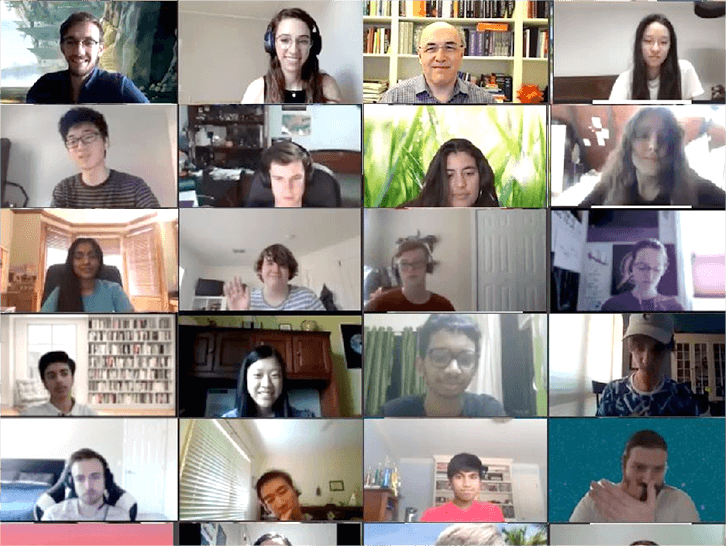
WELP:B students attend live Wolfram Language classes and then work in a small research group to complete a project. Projects are centered around a topic at the intersection of the group's interests.
 Need-based financial aid is available.
What You'll Learn
During WELP:B, you will attend live weekly classes before winter break and then go through the entire product development cycle, from brainstorming a potential project to creating a minimum viable product, iterating on your idea and producing an interesting and worthwhile project.

Collaboration Skills
At WELP:B, you will work in a team of three to five students from around the world. These groups are hand selected to both support and challenge each member. You will work together to find a project at the intersection of your interests, where each member has valuable skills to contribute. You will learn how to communicate, resolve conflict and innovate together.

Wolfram Language
During the first phase of the program, you will go through our active-learning boot camp experience to learn Wolfram Language in live classes led by Wolfram Language experts. From making facial recognition classifiers and randomizing setups for board games to creating computational music and art and making interactive websites, you will build up a portfolio of mini projects as you learn Wolfram Language.

Research Skills
As your team works together to write a computational essay, you will dive deep into the subject area, developing research skills and discovering new knowledge. You will learn how to present your findings—in writing, in code and in visualizations—as well as how to formulate, investigate and defend a thesis.

Computational Thinking
Computational thinking—the ability to translate complex thoughts into computable concepts—is a core part of WELP:B. You will learn how to express your thoughts in a systematic and clear enough way that a computer can understand them, while also learning how to structure your approach to problem solving.
What You'll Do

Learn Wolfram Language
In live weekly classes on Tuesdays at 8pm Central Time, you will learn Wolfram Language skills, explore computational thinking and learn to apply computational tools to complete a long-term research project. Between sessions, you will use the interactive Creative Computation course to develop mini projects and extend your skills.

Complete a Project
Each group completes a project of their own design, culminating in writing a computational essay. Topics in the past have ranged from generating constructed languages, to simulating plastic polymer degradation, to analyzing hash functions from deterministic graph walks, to generating 3D printer infill using cellular automata, to exploring functional iteration and roots.
The ultimate goal of the project is to dive deep into your chosen interest and create a visually stunning, interactive piece of work that combines text, code and visualizations.

Explore Your Next Steps
We want to support you as you make challenging decisions about your future academic- and career-related goals. You will have the opportunity to talk through college decisions, subject specialization choices and summer activities with trusted advisors and engage in professional development activities both individually and as a group.
Tuition and Financial Aid
Tuition for one year of WELP:B is $3000 and includes all you need to be successful in the program.
WELP:B runs from October to May, and this cost includes a one-year subscription to Wolfram|One; a one-year subscription to Wolfram|Alpha Pro; seven weeks of live Wolfram Language instruction; robust mentorship and support during the project development process; interactions with key employees at Wolfram; guidance on future education choices; a certificate of completion; and a letter explaining the program to prospective employers and educational institutions.
Financial aid is available for students who demonstrate financial need.
What Happens after WELP:B
On successful completion of WELP:B, any applications you submit to attend a summer research program at Wolfram will be given special consideration. For students still in high school, this would be the Wolfram High School Summer Research Program, and for students who graduate high school at the end of the year, this would be the Wolfram Summer Research Institute.
Graduates who are unable to attend an in-person program will be eligible to join the Wolfram Emerging Leaders Program: High School or Wolfram Emerging Leaders Program: Undergraduate.
Application Process
The application period opens in April, and we offer an Early Decision and a Regular Decision deadline.
For students who apply before the Early Decision deadline on May 25, we will notify you of the results of your application by June 12. You must accept or reject your offer and pay your deposit by June 22.
For students who apply before the Regular Decision deadline on August 31, we will notify you of the results of your application by September 14. You must accept or reject your offer and pay your deposit by September 28.
The full balance for the program is due on October 5 for all decision deadlines.
As we are committed to enabling ambitious students regardless of background or resources, need-based scholarships are available for students with demonstrable financial need. Financial aid applications must be submitted at the same time as the application, and students who require financial aid should apply as early as possible.
The first step is to fill out the application form, which goes live at the start of the application period. Along with essential information, students expand on their previous experiences and projects and explore project ideas.
The final part of the application is a video interview with our Admissions Director, where students expand on their coding challenge answers and their written application.
Classes take place online on Tuesdays at 8pm CT from October 27 to December 8. Students must attend all classes to continue to the project phase in January.